

Epidemiological dynamics#
This chapter introduces the basic deterministic models of infectious disease dynamics (SIR), focusing on threshold behaviour (\(R_0\)), vaccination (herd immunity), demography (endemic equilibria), and seasonal forcing (multi-year cycles).
It reuses the same ODE toolkit as earlier chapters, but the interaction here is between hosts and infection status rather than between species.
References: Kermack and McKendrick [1927]; Anderson and May [1991]; Keeling and Rohani [2008].
Note
Conventions used here
\(S(t)\): susceptible fraction (or count)
\(I(t)\): infectious fraction (or count)
\(R(t)\): recovered/removed fraction (or count)
import numpy as np
import matplotlib.pyplot as plt
from scipy.integrate import solve_ivp
Basic SIR model (no demography)#
A standard SIR model is:
Here:
\(\beta\) is the transmission parameter (contact × transmission probability)
\(\gamma\) is the recovery rate; mean infectious period is \(1/\gamma\)
If \(S(0)+I(0)+R(0)=1\) (fractions), then \(S+I+R=1\) is conserved.
Early growth and \(R_0\)#
At the start of an outbreak, \(S\approx S(0)\) is near 1. Then
So infections grow initially if \(\beta S(0) > \gamma\). Define the basic reproduction number (in this normalised setting):
More generally, if \(S(0)\neq 1\), early growth is controlled by \(R_0 S(0)\).
def sir_rhs(t, y, beta, gamma):
    S,I,R = y
    return [-beta*S*I, beta*S*I - gamma*I, gamma*I]

def simulate_sir(beta=1.5, gamma=1.0, y0=(0.999, 0.001, 0.0), t_end=20, n=2000):
    t_eval=np.linspace(0,t_end,n)
    sol = solve_ivp(lambda t,y: sir_rhs(t,y,beta,gamma), (0,t_end), list(y0),
                    t_eval=t_eval, rtol=1e-9, atol=1e-12)
    return sol.t, sol.y

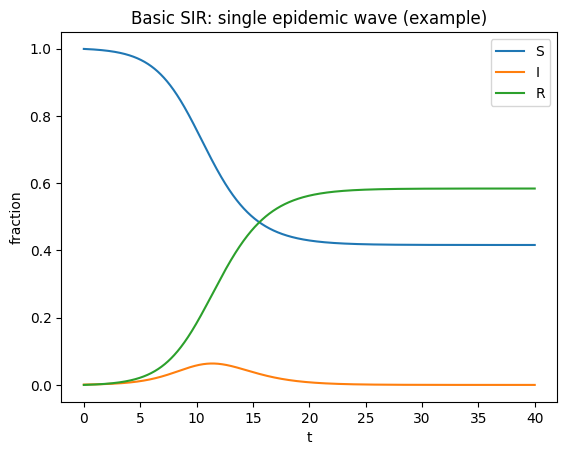
t,(S,I,R) = simulate_sir(beta=1.5, gamma=1.0, t_end=40)

plt.figure()
plt.plot(t,S,label="S")
plt.plot(t,I,label="I")
plt.plot(t,R,label="R")
plt.xlabel("t"); plt.ylabel("fraction")
plt.title("Basic SIR: single epidemic wave (example)")
plt.legend(); plt.show()
Vaccination and herd immunity#
If a fraction \(p\) of the population is immune at the start (perfect vaccination), the initial susceptible fraction is \(S(0)=1-p\).
Initial growth requires:
So the critical vaccination coverage is:
This is the classic herd immunity threshold.
SIR with demography (births and deaths)#
To model an endemic infection, include per-capita birth/death rate \(\mu\):
(Here we have normalised so total population is 1.)
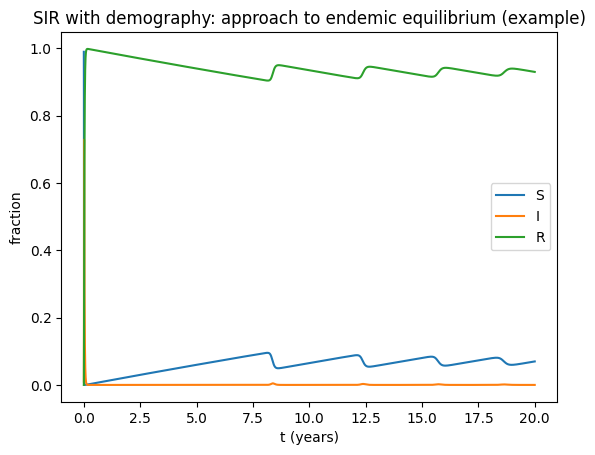
Then susceptibles are replenished by births, so infections can persist (endemic equilibrium) if \(R_0>1\).
A common form of \(R_0\) here is:
def sir_demo_rhs(t, y, beta, gamma, mu):
    S,I,R = y
    return [mu - beta*S*I - mu*S,
            beta*S*I - gamma*I - mu*I,
            gamma*I - mu*R]

def simulate_sir_demo(beta=750, gamma=52, mu=0.0125, y0=(0.99,0.01,0.0), t_end=10, n=5000):
    t_eval=np.linspace(0,t_end,n)  # time in years
    sol = solve_ivp(lambda t,y: sir_demo_rhs(t,y,beta,gamma,mu), (0,t_end), list(y0),
                    t_eval=t_eval, rtol=1e-9, atol=1e-12)
    return sol.t, sol.y

t,(S,I,R)=simulate_sir_demo(beta=750, gamma=52, mu=0.0125, t_end=20)

plt.figure()
plt.plot(t,S,label="S")
plt.plot(t,I,label="I")
plt.plot(t,R,label="R")
plt.xlabel("t (years)"); plt.ylabel("fraction")
plt.title("SIR with demography: approach to endemic equilibrium (example)")
plt.legend(); plt.show()
Periodically forced SIR (seasonality)#
Seasonality can be represented by periodic forcing of \(\beta\):
With forcing, the system is non-autonomous and can show:
annual cycles
multi-year cycles (e.g. 2-cycle, 3-cycle)
more complex (even chaotic) dynamics for some parameter ranges
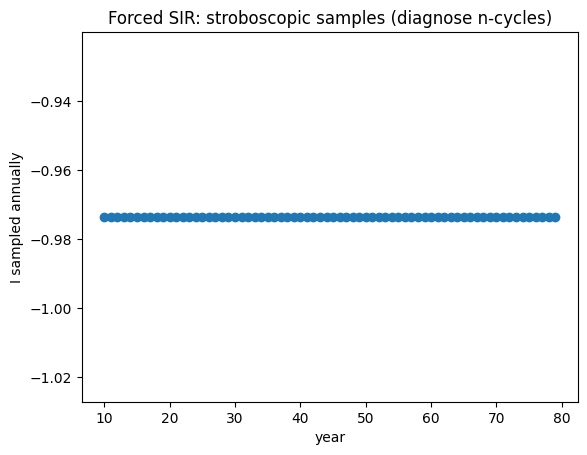
A practical way to diagnose an \(n\)-cycle is via a stroboscopic/Poincaré map: sample the state once per forcing period and look for repeating patterns.
def sir_forced_rhs(t, y, beta0, amp, omega, gamma, mu):
    S,I,R = y
    beta = beta0*(1 + amp*np.sin(omega*t))
    return [mu - beta*S*I - mu*S,
            beta*S*I - gamma*I - mu*I,
            gamma*I - mu*R]

def simulate_sir_forced(beta0=1200, amp=0.08, omega=2*np.pi, gamma=50, mu=0.0125,
                        y0=(0.99,0.01,0.0), t_end=200, step=0.002):
    # time in years; step ~ 0.002 years ~ 0.73 days
    t_eval = np.arange(0, t_end+step, step)
    sol = solve_ivp(lambda t,y: sir_forced_rhs(t,y,beta0,amp,omega,gamma,mu),
                    (0,t_end), list(y0), t_eval=t_eval, rtol=1e-8, atol=1e-10)
    return sol.t, sol.y

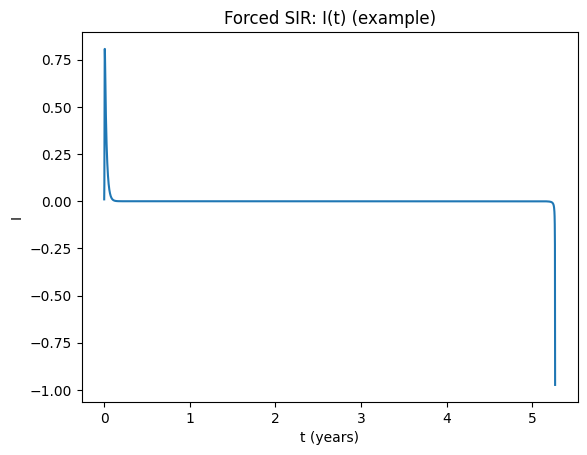
t,(S,I,R)=simulate_sir_forced(beta0=1200, amp=0.08, omega=2*np.pi, gamma=50, mu=0.0125, t_end=80)

plt.figure()
plt.plot(t,I)
plt.xlabel("t (years)"); plt.ylabel("I")
plt.title("Forced SIR: I(t) (example)")
plt.show()

# Poincaré sampling once per year
T = 2*np.pi/(2*np.pi)  # with omega=2*pi, period is 1 year
years = np.arange(10, 80, 1.0)
I_sample = np.interp(years, t, I)

plt.figure()
plt.plot(years, I_sample, marker="o", linestyle="none")
plt.xlabel("year"); plt.ylabel("I sampled annually")
plt.title("Forced SIR: stroboscopic samples (diagnose n-cycles)")
plt.show()
Summary#
In the basic SIR model, early epidemic growth occurs when \(R_0 S(0) > 1\); in the fully susceptible limit \(S(0)\approx 1\), this reduces to the familiar threshold \(R_0>1\).
Vaccination reduces the initial susceptible fraction; the herd-immunity threshold in the simplest setting is \(p_c = 1 - 1/R_0\).
Adding demography (\(\mu\)) replenishes susceptibles and allows endemic equilibria; a common threshold form is \(R_0 = \beta/(\gamma+\mu)\).
Seasonal forcing makes the system non-autonomous and can generate multi-year cycles that are easy to diagnose using stroboscopic (Poincaré) sampling.